

Ordinarily Available Guidance

In Birmingham, we want every child and young person to belong, be understood, and thrive.

Our shared commitment is to recognise strengths, interests, and potential and to create welcoming learning environments that are inclusive, nurturing, and ambitious for all.

Education settings across Birmingham work together so that every child and young person can participate, feel safe, and achieve their full potential. We know that understanding each learner’s strengths and needs, and planning well-coordinated support, leads to the best outcomes for all our children and young people.

The Ordinarily Available Guidance (OAG) helps all schools and education settings maintain high-quality, inclusive practice. It provides a clear, shared expectation of what we do every day to create inclusive classrooms and learning environments.
About Birmingham’s OAG

Ordinarily available provision refers to the strategies, adaptations and experiences that remove barriers to learning within a school or setting’s existing resources. It supports all children and young people, including those with additional or special educational needs, and forms part of high-quality everyday practice.  

This guidance is not a checklist, assessment or an audit tool. Every setting will adapt the examples to suit its age phase, context, community and children’s needs. Children and young people with an Education, Health and Care Plan (EHCP) will also benefit from the same inclusive approaches contained in this guidance, alongside the personalised provision detailed in their plan. 

The guidance is designed to:

  • Provide clear examples of high-quality, inclusive teaching and learning 
  • Enable staff to respond to children and young people’s strengths and needs 
  • Promote collaboration with parent carers and partner professionals 
  • Encourage ongoing reflection and celebrate what is working well 

The Ordinarily Available Guidance (OAG) is for everyone working with children and young people in Birmingham’s education settings, not only teachers and SENCos, but all adults who help create an inclusive environment every day.  

This includes leaders, teaching assistants, pastoral and support staff, lunchtime supervisors, receptionists, site and catering teams, governors, local authority SEND services, and partner professionals and organisations across education, health and social care.  

The OAG can also help parent carers and children and young people to understand what inclusive practice looks like in Birmingham and what support can be provided in mainstream settings. 

It can be used to: 

  • Support whole-school learning, development, and induction 
  • Guide professional conversations in team meetings, reviews, and supervision 
  • Strengthen partnership working with parent carers and external professionals 

This guidance is organised into two connected sections. Together, they set out what inclusive practice looks like across a whole school and how that practice is applied in day-to-day teaching and support

Section One: Expectations for Inclusive Practice in All Settings

Section One sets out the whole-school expectations for inclusive practice that all education settings in Birmingham are expected to have in place for all children and young people, including those with SEND. It is structured around 10 key principles that describe what strong, inclusive practice looks like across a setting.

Section Two: Support for the Four Broad Areas of Need

Section Two supports teachers and support staff with day-to-day inclusive practice. It is organised around the broad areas of need in the SEND Code of Practice (2015) and describes what we might see and what we can do to support learning and participation. The strategies reflect ordinarily available provision within mainstream settings and can be used flexibly, recognising that many children and young people have needs across more than one area.

This guidance has been co-produced with SENCOs, parent carers, school leaders and SEND professionals across the Local Area Partnership in Birmingham. It reflects the collective experience and expertise of those who work directly with, and care for, children and young people and their families. 

As a living framework, the guidance will continue to evolve. We welcome feedback from schools, settings and families on what is working well and where further development may be helpful. If you have reflections or suggestions, please share these with us at senconoticeboard@birmingham.gov.uk

We are also keen to continue building the OAG Digital Library. If your setting has examples of inclusive practice, resources or approaches that align with the guidance, we would love to hear from you. These can be developed into showcases to support and inspire practice across the city. Please email senconoticeboard@birmingham.gov.uk if you would like to share your inclusive practice with us!  

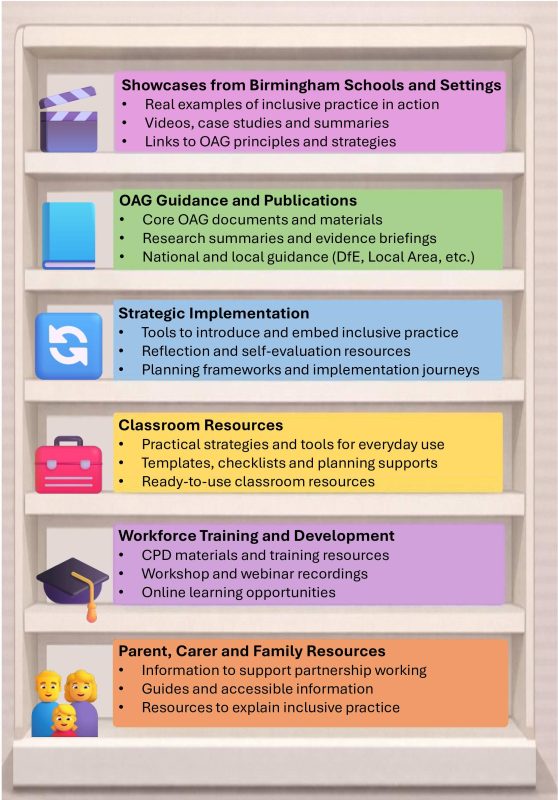
The OAG Digital Library supports schools to move from guidance to implementation.  

It brings together a wide range of support designed to help schools understand and apply Birmingham’s Ordinarily Available Guidance. This includes practical tools, research, training and resources, all organised into clear “shelves” so practitioners can easily find what they need. Whether that’s classroom strategies, implementation guidance, professional learning or information to support partnership with parents and carers. 

At the heart of the library are Showcases. These are real examples of inclusive practice from Birmingham schools and settings, highlighting what is already happening across the city to support children and young people. Each showcase connects directly to the OAG, helping to illustrate how the guidance can be put into practice in real contexts. 

We are continually growing this library and warmly invite schools and settings to contribute. By sharing what is already working well, we can build a collective, city-wide picture of inclusive practice that supports all children and young people. Please email senconoticeboard@birmingham.gov.uk if you would like to share your inclusive practice with us! 

A graphic depicting the layout of the the digital library shelves

Parent carers have played a vital role in shaping Birmingham’s Ordinarily Available Guidance. 

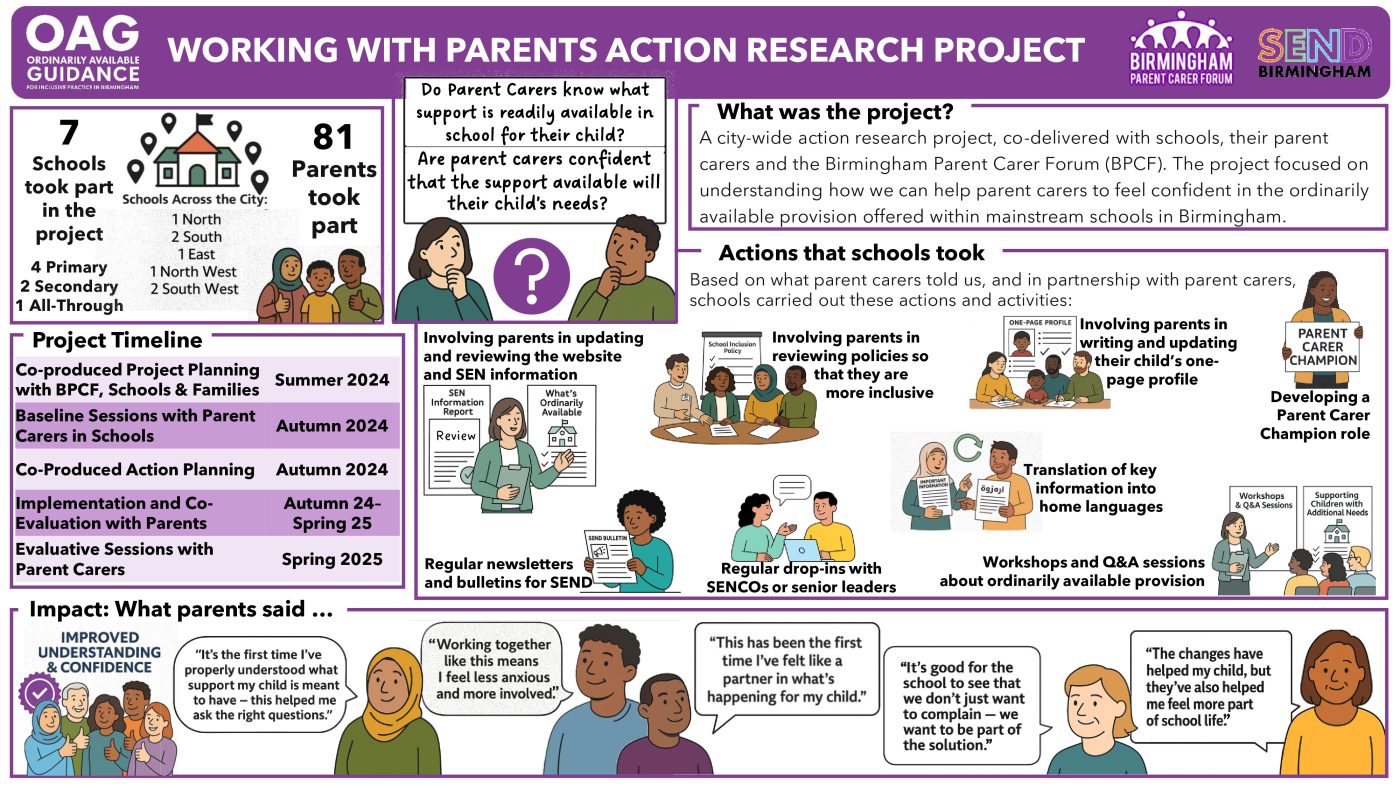
Seven Birmingham schools took part in a collaborative action research project, working alongside parent carers and the Birmingham Parent Carer Forum (BPCF) to strengthen partnerships and improve understanding of what support is ordinarily available. 

Together, they explored two key questions: 

  • Do parent carers understand what support is available?  
  • Are they confident it will meet their child’s needs?  

Through co-produced activity, schools and families made practical changes – including clearer communication, regular drop-ins, co-produced resources and parent-friendly guides. 

Download: Explore the Stories of Implementation to see how schools have put this into practice.

An image providing an overview on the parent carers action research project for the Ordinarily Available Guidance

We have worked closely with the Parent Carer Reference Group (PRG) to review and shape the guidance. This has helped ensure the language is clear, accessible and grounded in real family experience. 

In response to parent feedback, the OAG Parent Carer Guides have been co-produced to support confident conversations between families and schools. 

A black triangle with, PCG in the middle. This is clickable, and will open a parent carer guide on the corresponding area within section one of the OAG

Whilst browsing through the OAG, look out for this icon. Clicking it will open the parent carer guide to the corresponding area of section one.

 Download: OAG Parent Carer Guides Pack 

More Coming Soon – We are continuing to build this area, with more information and support for parent carers coming soon. 

Accessibility Plan A school’s plan for improving access to the environment, curriculum and information for pupils with disabilities.
Assess – Plan – Do – Review The four-stage cycle used to understand needs, put support in place, and review its impact.
Belong. Matter. Thrive. The vision at the heart of Birmingham’s OAG – that every child and young
person should feel they belong, know they matter and be supported to
thrive.
Early Identification Spotting a child’s additional needs as early as possible so support can start quickly
EHCP (Education, Health, Care Plan) A legal document setting out the support required for a child or young person with significant and complex needs.
Graduated Approach A cyclical process of Assess → Plan → Do → Review used to identify needs and plan, deliver and review effective support.​
Inclusive Practice Everyday approaches that make sure every learner can take part and succeed, whatever their needs or background.
Local Offer Birmingham’s website providing information about SEND services, support and guidance for children, young people and families.
Ordinarily Available Guidance Birmingham’s shared framework describing the provision and strategies that should be available for all children and young people, without the need for an EHCP.
Pupil Passport / One Page Profile A short summary of a pupil’s strengths, needs and helpful strategies, often created with the pupil and their family.
Reasonable Adjustments Changes made by a school to remove or reduce barriers to learning, in line with the Equality Act 2010.​
Section 1 – Principles of Inclusive Education Ten key principles that set out what inclusion looks like across Birmingham’s schools and settings.
Section 2 – Strategies for Classroom Practice Practical strategies and approaches to support teachers and staff in removing barriers to learning.
SENCo (Special Educational Needs and Disabilities Coordinator) The teacher who leads and coordinates support for pupils with SEND within a school.
SEND (Special Educational Needs and/or Disabilities) A term describing children and young people who need extra support to learn and take part in school life.
SEN SUpport The help that children and young people can get to reduce barriers to learning and participation.
Stories of Implementation Examples from Birmingham schools showing how they have put the OAG into practice.
Targeted Provision Support that is ordinarily available in addition to universal provision, delivered to identified pupils who need more than high-quality teaching alone.

Transitions Planned support to help children move smoothly between year groups or settings.​
Universal Provision The high-quality, inclusive teaching that should be in place for all pupils in every classroom.
Accessibility Plan
A school’s plan for improving access to the environment, curriculum and information for pupils with disabilities.
Assess – Plan – Do – Review
The four-stage cycle used to understand needs, put support in place, and review its impact.
Belong. Matter. Thrive.
The vision at the heart of Birmingham’s OAG – that every child and young
person should feel they belong, know they matter and be supported to
thrive.
Early Identification
Spotting a child’s additional needs as early as possible so support can start quickly
EHCP (Education, Health, Care Plan)
A legal document setting out the support required for a child or young person with significant and complex needs.
Graduated Approach
A cyclical process of Assess → Plan → Do → Review used to identify needs and plan, deliver and review effective support.​
Inclusive Practice
Everyday approaches that make sure every learner can take part and succeed, whatever their needs or background.
Local Offer
Birmingham’s website providing information about SEND services, support and guidance for children, young people and families.
Ordinarily Available Guidance
Birmingham’s shared framework describing the provision and strategies that should be available for all children and young people, without the need for an EHCP.
Pupil Passport / One Page Profile
A short summary of a pupil’s strengths, needs and helpful strategies, often created with the pupil and their family.
Reasonable Adjustments
Changes made by a school to remove or reduce barriers to learning, in line with the Equality Act 2010.​
Section 1 – Principles of Inclusive Education
Ten key principles that set out what inclusion looks like across Birmingham’s schools and settings.
Section 2 – Strategies for Classroom Practice
Practical strategies and approaches to support teachers and staff in removing barriers to learning.
SENCo (Special Educational Needs and Disabilities Coordinator)
The teacher who leads and coordinates support for pupils with SEND within a school.
SEND (Special Educational Needs and/or Disabilities)
A term describing children and young people who need extra support to learn and take part in school life.
SEN SUpport
The help that children and young people can get to reduce barriers to learning and participation.
Stories of Implementation
Examples from Birmingham schools showing how they have put the OAG into practice.
Transitions
Planned support to help children move smoothly between year groups or settings.​
Universal Provision
The high-quality, inclusive teaching that should be in place for all pupils in every classroom.